
A practical SEO outline for brands sourcing custom tracksuits from a low-MOQ factory in China, covering fabrics, fit, decoration, sampling, pricing, and...
If you are searching for a custom tracksuit factory low MOQ China option, the real question is not only who can make tracksuits. It is who can make them at a workable minimum order quantity, keep the fit consistent, control fabric and trim quality, and still leave room for branding details that matter in retail, teamwear, and promotional programs. For many buyers, especially emerging brands and private label customers, the right supplier is the one that balances flexibility with basic manufacturing discipline.
China remains a leading sourcing base for custom tracksuits because it offers access to knitted fabrics, color matching, embroidery, printing, pattern development, and a broad range of garment finishing options. A low MOQ factory can be useful when you are testing a new line, launching seasonal capsules, or comparing several fabric weights before committing to larger volume. The tradeoff is straightforward: lower quantities often mean higher unit cost, tighter material availability, and more dependence on clear tech packs and sample approvals.
Custom Tracksuit Factory Low MOQ China - Clothing Manufacturer manufacturing guide
In apparel sourcing, MOQ means minimum order quantity. For custom tracksuits, the MOQ can apply to total units, per color, per style, or per fabric type. A factory may accept 100 sets as a total order, but require at least 50 sets per color or 30 sets per size breakdown. That distinction matters. A buyer may hear “low MOQ” and assume the project is simple, when in practice the supplier still needs enough volume to justify cutting, printing, dyeing, and setup work.
Low MOQ is not a universal number. In China, a custom tracksuit factory may consider 100 to 300 sets low for a fully customized program, while some stock-fabric or simple decoration projects may go lower. On the other hand, a heavily customized tracksuit with special ribbing, custom zipper pulls, woven labels, and unique color blocking may need a higher minimum to stay commercially viable.
For buyers, the key is to ask which part of the order drives the minimum. Is it the fabric mill minimum, the dye lot minimum, the embroidery setup, or the sewing line efficiency? A good supplier should be able to explain this clearly.
China has depth across the apparel supply chain, which is one reason buyers continue to search for a custom tracksuit factory low MOQ China partner. Tracksuits are knitted garments, and knitted apparel production depends on fabric availability, pattern accuracy, and stable sewing quality. Chinese suppliers often have access to polyester knit, cotton-poly blends, brushed back fleece, interlock, tricot, mesh lining, and related trims in a wide range of weights and finishes.
There are practical advantages to this sourcing base:
There are tradeoffs as well. Not every factory is equally strong in low MOQ programs. Some are set up for bulk production and will quote low MOQ only if the buyer accepts limited customization. Others can do smaller orders but may need longer preparation time or a more focused product spec. The best sourcing decision depends on your product’s complexity and your market price point.
There is no single industry standard, but the ranges below are commonly encountered in low MOQ sourcing discussions. These are directional only, not promises.
Tracksuit Type Typical Low MOQ Range Notes Basic polyester tracksuit with simple logo 100–300 sets Often the easiest option for low MOQ programs Cotton-poly knit tracksuit 150–300 sets Depends on fabric availability and color matching Fully custom design with special trims 300–500 sets Higher setup demands and stronger quality control needs Printed or sublimated tracksuit 100–200 sets MOQ may depend on print method and artwork complexity Sample or pre-production set 1–3 sets Used for fit and workmanship approval, not bulk deliveryBuyers should be careful with the phrase “custom” because it can mean many things. If you only need a standard silhouette with your brand logo, the MOQ may stay low. If you want custom panels, custom zipper tape, custom jacquard rib, or a special dyed fabric, the order will usually need more volume or a higher price per set.
Tracksuits are judged quickly by feel, fit, and finish. Fabric choice often determines whether the set feels athletic, premium, or promotional. Common options include polyester tricot for smooth sportswear looks, polyester fleece for warmth, cotton-poly fleece for comfort, and interlock for a cleaner, more structured hand feel. Lightweight mesh linings may be used in jackets for breathability, while brushed interiors add softness for cooler seasons.
Fabric specifications should be written down clearly. A proper tech pack should include GSM, fiber composition, knit structure, stretch recovery expectations, and color references. If the garment must perform in active use, ask about pilling resistance, shrinkage tolerance, and colorfastness. If the tracksuit is more fashion-led, the hand feel and drape may matter more than performance metrics, though basic stability still matters.
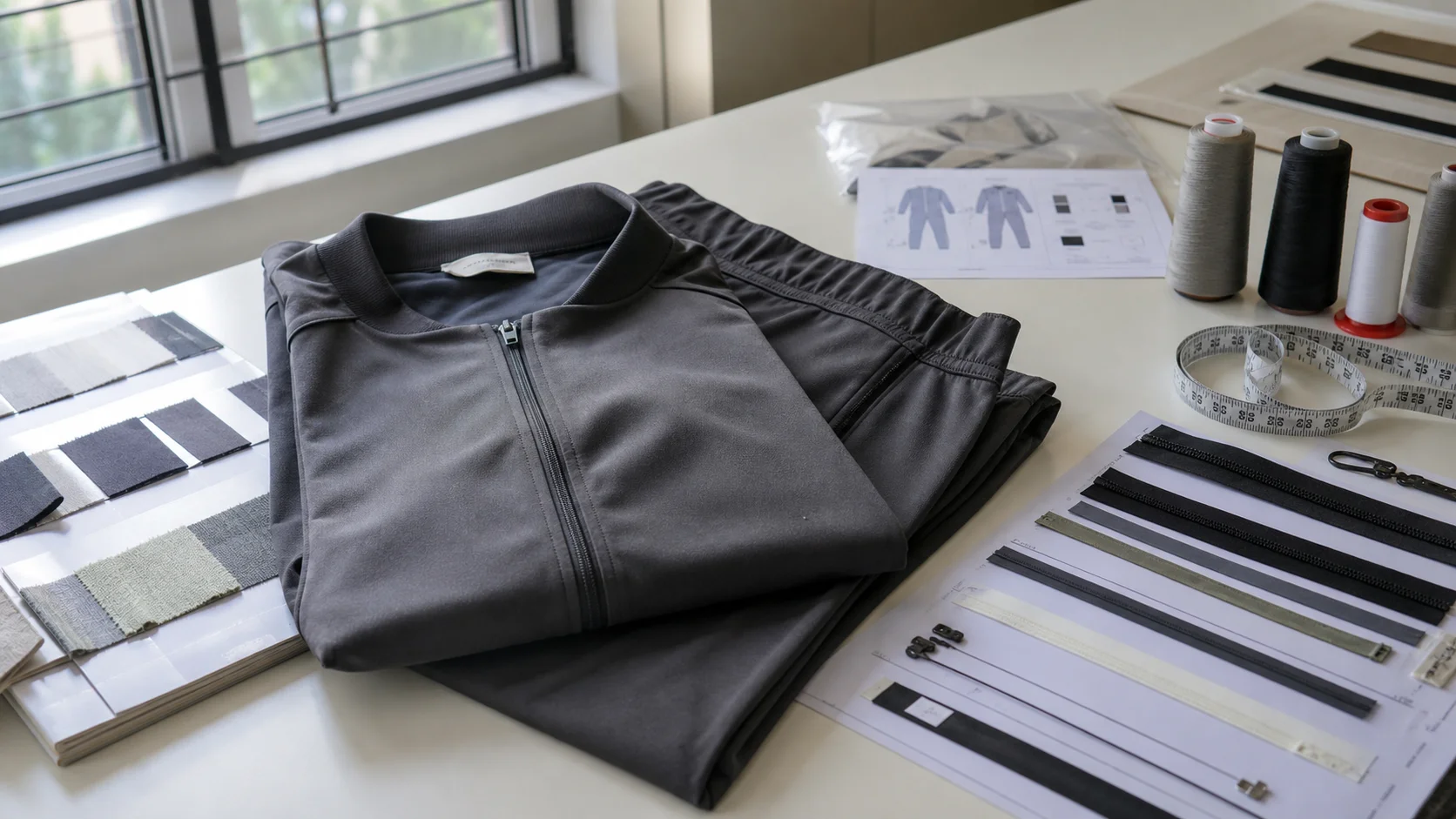
Trims deserve equal attention. A low MOQ order can go wrong when buyers overlook zipper quality, drawcord end finishing, elastic recovery, label placement, or seam reinforcement. For example:
Construction details affect both appearance and cost. Flatlock seams can improve comfort on activewear but may increase production complexity. Topstitching is common and practical, yet the stitch density must be consistent. Pocket bags, panel alignment, and stripe placement require careful cutting and sewing discipline. If the design uses color blocking, the factory must manage panel matching and seam accuracy with care.
A low MOQ tracksuit order should still follow a proper production sequence. Skipping steps can create avoidable errors, even in smaller runs.
Start with a tech pack or a clear product brief. Include measurements, size range, fabric choice, logo placement, color references, trim details, packaging requirements, and label information. The clearer the brief, the fewer revisions later.
The quote should separate fabric, sewing, printing or embroidery, labeling, packaging, and sampling charges if possible. A single all-in price may be easier to read, but it hides where the cost pressure sits. If you plan repeat orders, ask whether the price improves at larger volume.
For custom tracksuits, sample approval is the point where many projects either stay on track or drift. Expect at least one round of sample development. In some cases, a fit sample comes first, then a corrected pre-production sample. Check measurements, seam quality, logo size, zipper performance, shrinkage behavior, and overall silhouette. Do not rush this step.
Before bulk production begins, the factory should confirm fabric, colors, trims, and packaging materials. If a particular shade is critical, request a lab dip or color approval. If your order relies on one specific zipper style or rib type, confirm availability before cutting starts.
Once everything is approved, cutting and sewing begin. For low MOQ orders, production may move faster than large programs, but it can also be more vulnerable to interruption if fabric delays occur. Ask for progress updates at major checkpoints.
A final inspection should review sizing, workmanship, logo accuracy, stains, measurement tolerance, packaging, and carton marks. Even a small order benefits from some level of inspection. Smaller runs are not immune to inconsistency.
Lead time for a custom tracksuit factory low MOQ China order depends on the design complexity, fabric sourcing, decoration method, and approval speed. A simple set made from ready fabric may move faster than a fully custom style requiring special dyeing or trims.
Typical timing often falls into these broad stages:
Several factors can extend lead times:
The practical lesson is simple: low MOQ helps with entry volume, but it does not eliminate planning time. Buyers still need to build in room for sampling, approval, and correction.
Tracksuits may look straightforward, but quality issues often show up in detail work. Common risks include uneven measurements between pieces, twisted seams, weak stitching at stress points, loose threads, poor print alignment, and inconsistent color matching between jacket and pants. A buyer ordering low MOQ should not assume that small volume means small risk.
Inspection should focus on the following:
One common sourcing mistake is to treat the approved sample as the final benchmark without documenting tolerances. A proper approval should include acceptable variation ranges. Without that, a factory may consider a slightly different fit acceptable while the brand sees it as a defect.
Low MOQ does not mean low standards. It usually means the buyer has less leverage, so the specification has to do more of the work.
Price for a custom tracksuit is driven by fabric cost, trims, labor, print or embroidery complexity, packaging, and order size. Low MOQ almost always means a higher unit price than a larger program. That is not a flaw in the factory. It reflects setup costs spread across fewer units.
When comparing quotes, look beyond the headline number. A lower quote may exclude packaging, labels, or freight-ready packing. Another quote may use heavier fabric or a better zipper. The cheapest option is not always the best value if the fit is poor or the finished product lacks durability.
Useful cost drivers to compare:
Buyers should also ask whether the factory offers price breaks at repeat order volume. In many cases, the first low MOQ order is a development run. If the product sells well, the second and third orders can be priced more efficiently.
When evaluating a Chinese custom tracksuit factory, the most useful questions are practical ones. Can they explain their low MOQ policy clearly? Do they understand sportswear construction? Can they communicate sample revisions in writing? Do they provide measurement sheets, color approvals, and production updates in a structured way?
Look for these signs of a workable supplier:
A factory that promises everything immediately may be less reliable than one that explains limitations honestly. In sourcing, clarity is usually more valuable than enthusiasm. A responsible supplier will tell you where the cost or lead time pressure sits before you place the order.
Tracksuits give brands several ways to present identity. The best option depends on the target customer, price point, and garment style. For a clean athletic look, embroidery on the chest or thigh can work well. For a modern lifestyle look, heat transfer or silicone prints may feel more appropriate. Screen printing remains cost-effective for simple logos and graphic applications. Woven labels and branded hangtags support retail positioning but add small cost and setup work.
Choose branding methods carefully:
Do not overload the garment with too many branded elements. Each added decoration point increases complexity, and complexity can hurt both quality and margin at low MOQ.
If you are buying from a custom tracksuit factory low MOQ China supplier, a disciplined sourcing approach will save time and reduce mistakes.
It also helps to think about the end use of the product. A tracksuit for teamwear may prioritize durability and easy laundering. A fashion tracksuit may prioritize drape, color consistency, and finish. A promotional set may focus on cost and logo visibility. The right factory choice depends on which of those matters most.
If you are comparing suppliers and need a structured sourcing path, Fabrikn is worth reviewing for its clothing manufacturing support, service information, and contact options. Start with the services page to understand the scope of production support, then review the about us page for background on how the company positions its manufacturing work. If you already have a tech pack or a concept in hand, the contact us page is the most direct place to begin a quote discussion.
The most useful supplier is rarely the one with the biggest claim. It is the one that can move a product from idea to sample to bulk order without confusion. For low MOQ tracksuit programs, that discipline matters even more because there is less room to absorb mistakes.
Get a free quote from Fabrikn — your trusted B2B clothing manufacturer with 10+ years of experience. MOQ as low as 200 pieces.
Get a Free Quote →It depends on the design, fabric, and decoration method. Some basic programs may start around 100 sets, while more customized styles often sit at 300 sets or more. Ask whether the MOQ applies per style, per color, or per fabric.
Usually yes, but the size ratio should be agreed in advance. Some factories will accept mixed size runs if the total quantity is sufficient, though a very wide size spread may increase cutting and packing complexity.
At least one sample is common, and two rounds are often safer if the fit or construction is new. A fit sample followed by a corrected pre-production sample is a sensible process for custom tracksuits.
There is no single best fabric. Polyester tricot suits smooth sportswear, fleece suits warmer lifestyle use, and cotton-poly blends offer a softer feel. The right choice depends on target customer, price point, and season.
Common risks include inconsistent sizing, weak stitching, logo misalignment, zipper problems, color variation, and packaging errors. Low MOQ does not remove these risks, so inspection remains important.
For a simple low MOQ tracksuit order, sample and bulk production together may take several weeks. Fabric sourcing, approval delays, and custom decoration can extend the timeline.
Yes, usually on a unit basis. Smaller orders spread setup and material preparation costs across fewer pieces. The upside is lower inventory risk and easier product testing.
For brands, teams, and retailers looking to launch tracksuits without overcommitting on volume, a good low MOQ factory in China can be a practical entry point. The strongest results usually come from clear specifications, realistic expectations, and a supplier that understands both production limits and quality control basics.